Analytics and learning
YouTube analytics that learns without touching what it should not
Every day CLAQON collects YouTube analytics for your pieces, learns which hooks, topics and formats retain viewers best on each account and adjusts only safe levers, with safeguards and rollback. What is not measured is not made up, and the important things – content, voice, schedules or budget – only arrive as proposals.
- YouTube metrics every day
- Changes only with sufficient evidence
- Rollback if a change makes things worse
What it solves
Learning from what you publish without losing control of the channel
Reviewing by hand which piece retained viewers best, and why, takes time, and with few pieces it is easy to draw conclusions from noise. Letting a tool change the channel blindly is worse.
CLAQON only learns when there is a sufficient sample, adjusts within bounded margins and never changes the fundamental decisions on its own. Every change is logged, measured again and undone if it makes things worse.
How it works
How CLAQON learns from your metrics
It collects the metrics
Every day at 09:00: views, likes and comments; retention, if you grant YouTube Analytics permission; and estimated revenue, if the channel is monetised.
You fill in what is missing
From Metrics you record by hand the observations at 24 hours and at 7 days.
It calibrates before giving an opinion
Learning stays “calibrating” until it has 20 observations and 5 per group (8 if revenue is included). Then it becomes “active”.
It adjusts, it does not impose
The multipliers by language, account, format and hook move the ideas’ score between ×0.9 and ×1.15 and suggest the hook to the AI model, without imposing it.
It tests and reverts
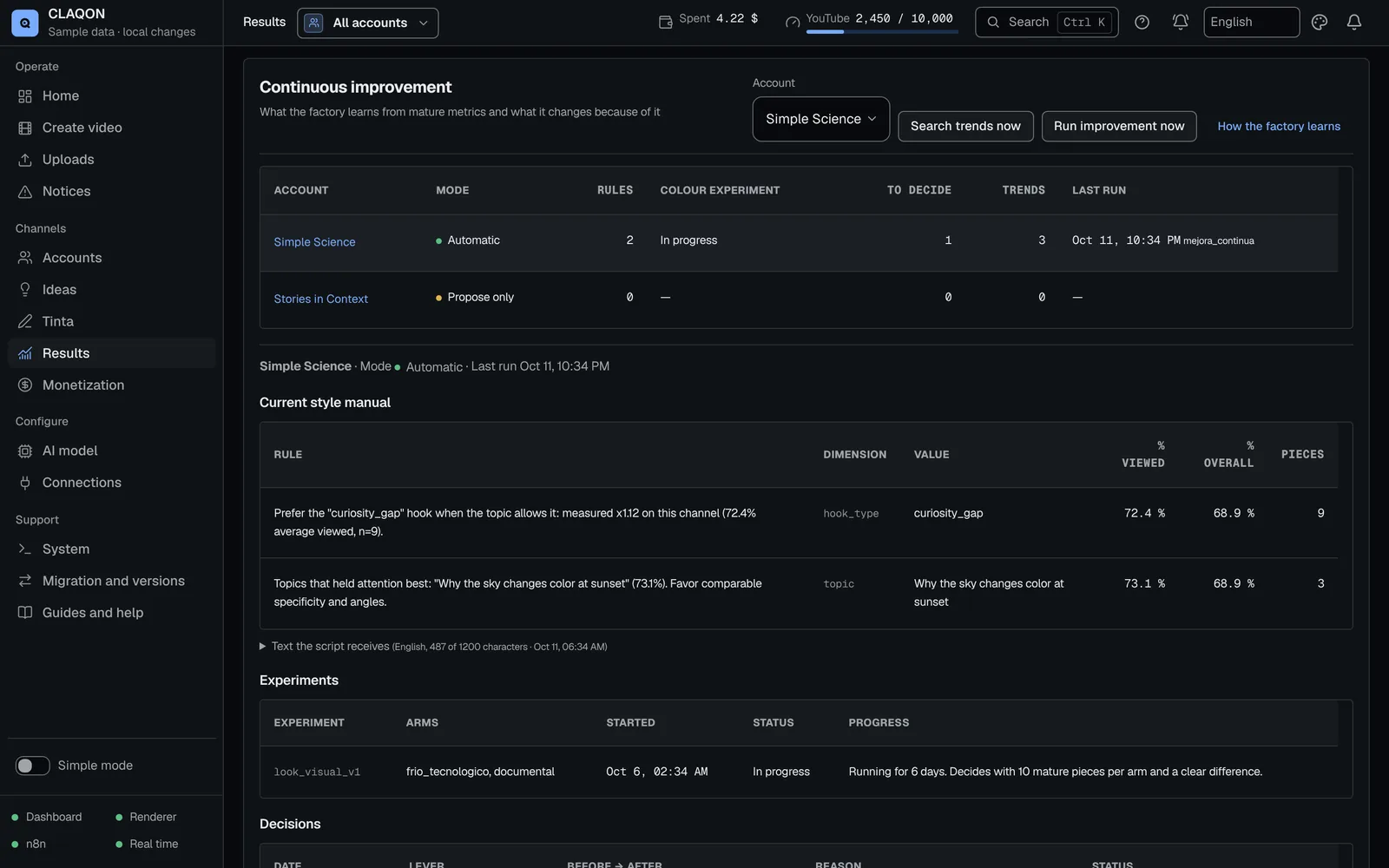
Continuous improvement changes one safe lever, measures it again and undoes it automatically if retention gets worse.
Capabilities
Metrics, continuous improvement and trends
- YouTube metrics
- Views, likes and comments (YouTube Data), retention (YouTube Analytics) and estimated revenue with its permission. If a source fails, its data is not filled in.
- Manual entry
- At 24 hours and at 7 days (T+24 h and T+7 d): views, percentage viewed, revenue and clicks.
- Continuous improvement Beta
- Modes: Automatic (default), Propose only or Off. Levers: caption capitalisation, colour grading with an A/B test, a learned style guide, hook exploration and idea priority.
- Safeguards
At least 10 pieces per variant, a Welch’s t of 2 or more and 4 points in percentage viewed.
One automatic change every 7 days per account, re-evaluated after 8 pieces and 5 days, with rollback if it makes things worse.
- Mature metrics only
- Continuous improvement uses YouTube Shorts that have been published for 3 days or more. The other platforms have no automatic metrics.
- Daily trends Beta
- The most watched in the market and the niche on YouTube, plus news from SearXNG and Tavily, scored from 0 to 100. It keeps the top 10 per account and, in automatic mode, turns the strongest into 2 or 3 ideas.
- Learned slot Beta
- It proposes a better publishing time when there is evidence. It never applies it on its own.
- Meta metrics Off by default
- Only with the button and Meta’s insights permission.
- Affiliate offers
- You record the commission, average order value and observed results, and CLAQON calculates their expected value per 1,000 views with your data, smoothing small samples.
- Daily cap for continuous improvement
- Per account: 1 model call, up to 250 YouTube Data units and 1 Tavily search.
What it never changes on its own
Decisions that are always yours
Continuous improvement never changes the account’s content on its own – niche, video type, format – nor the voice, schedules, visual provider, budget, platforms or length. Those only arrive as a proposal with its own button.
In “Propose only” mode, every change waits for your click. In “Off”, CLAQON only measures. And with the global switch off, it measures without writing anything or spending on paid services.
Limits
Limits worth knowing about
- Automatic metrics come from YouTube. Meta’s only with its button; none for X or the text networks.
- With few pieces, learning stays “calibrating”: there are no shortcuts for the sample.
- Retention and estimated revenue need YouTube Analytics permissions; revenue also needs a monetised channel.
- YouTube trends need a YouTube Data key; Tavily is optional.
- Continuous improvement, trends and the learned slot are in beta.
- The expected value of an offer is an estimate based on your data, not a revenue forecast.
Frequently asked questions
Questions about analytics and learning
Which metrics does it collect, and where from?
From YouTube: views, likes and comments through the Data API; retention through YouTube Analytics; and estimated revenue if the channel is monetised and you grant permission. What cannot be measured is not made up: if a source fails, learning keeps saying that it lacks a sample.
When does it start learning?
When it has 20 complete observations and 5 per group (8 if it uses revenue). Until then the status is “calibrating” and its multipliers are not applied.
Can it change my channel without me knowing?
It only touches safe levers, such as caption capitalisation or colour grading, at most once every 7 days and leaving a record, with a summary on Slack if you use it. If you would rather decide yourself, “Propose only” mode turns every change into a button.
Does it ensure more views or more income?
No. No tool can honestly promise that. CLAQON measures, adjusts cautiously and undoes whatever makes things worse; the result depends on your content and your audience.
How does it calculate the value of an affiliate offer?
It multiplies the click probability, the conversion probability and the net commission, using your observed results. With small samples it smooths the data so as not to reward noise.
Early access
Learn from your videos methodically
Tell us how many pieces you publish and what you measure today. We will tell you what CLAQON can learn from your channels, and from when.